 Chat
ChatVCU Libraries launches digital collection of Richmond Civil Rights-era films
August 13, 2025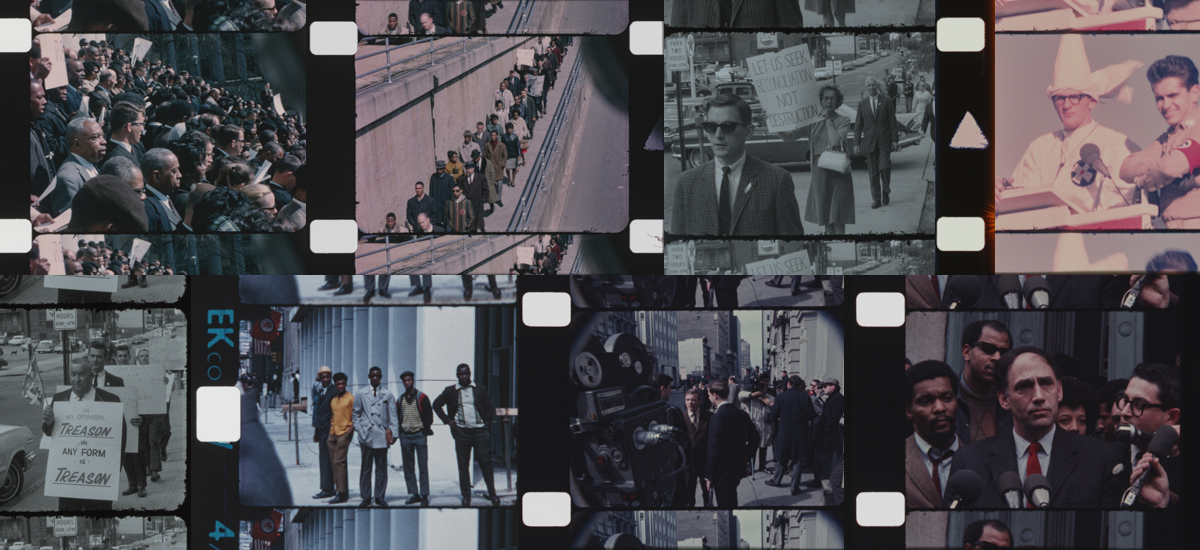
A new digital collection offers a rare window into Richmond’s civil rights era and the individuals who helped shape it in the early 1960s and 1970s.
This significant historical collection of police surveillance footage includes local meetings of the Black Panther Party, Dr. Martin Luther King Jr.’s Poor People’s Campaign of 1968, marches and memorial activities following MLK’s assassination, anti-Vietnam War protests, American Nazi Party rallies, Ku Klux Klan parades and marches against school desegregation busing. Films also show student protests from Richmond Professional Institute (RPI), Virginia Commonwealth University (VCU), Virginia Union University (VUU), and Virginia State College (now Virginia State University). Some films feature activities in Virginia locales outside of Richmond and Washington, D.C.
The films help bring these pivotal public events to life. “Often, much of the protest footage from the civil rights and anti-Vietnam War era is in black and white, which can make some of these events feel distant from our current reality. Having these moving images of individuals making their voices heard in full color reminds us that these historical movements were not really that long ago,” says Digital Initiatives Librarian Irina Rogova.
During the turbulent years of the 1960s and 1970s, the Richmond Police Department surveilled groups, people and events they determined to be subversive, counter-cultural or threatening. Most of the films were taken at public events, with officers filming from the street-level sidelines or even embedded in the event. While it appears the department was primarily focused on the Civil Rights, Black Power, Women's Rights, and Anti-War movements, they also surveilled those involved with the White Power and anti-integration movements.
The collection was acquired in 2017, but the films are only now available for researchers because intense restoration was needed. The original film reels were deteriorating and viewing them could have caused more damage. Last year, VCU Libraries received a $24,585.00 grant from the Council on Library and Information Resources (CLIR) to support the preservation of the Films of Richmond Police Department (RPD) Surveillance Records (1961-1973). The award was part of CLIR’s “Recordings at Risk” program, which is made possible by funding from the Mellon Foundation. Details about the project grant.
“Thanks to the Recordings at Risk grant, we are now able to make this footage widely accessible to all,” said Head of Special Collections and Archives Chrystal Carpenter. “By preserving and sharing this material, we aim to foster meaningful scholarship, community dialogue and intergenerational reflection on the city’s legacy of activism.”
The restoration process was complex and required technical expertise, research and fact-checking from various libraries departments and faculty.
Following digitization by The MediaPreserve, an audiovisual preservation company, the films were ingested into APTrust to ensure long-term preservation. Senior Curator Margaret Turman Kidd oversaw that work with the academic library consortium digital preservation platform.
Then, Rogova set to work on viewing and describing the footage, which took several months and deep dives into the archives of the Richmond Times-Dispatch, Proscript, and Commonwealth Times. Some reels lacked labels and some were labeled with incorrect dates. Rogova searched the newspaper archives for locations–many marches started in Monroe Park and ended at the Virginia State Capitol–and sometimes even the text on protest signs to deduce which events were being filmed. “One reel I was able to identify by looking up the text of a sign–Peace Through This War Is An Illusion–in the Richmond Times-Dispatch.” The search led to an April 29, 1967, clergy-led picket against the Vietnam War outside the Richmond Federal Building.
Today, 112 films are available online via Scholars Compass. Additional films are available by request in Special Collections and Archives. Audio recordings, discovered during the digitization process, will be added to the collection in the fall. A finding aid for the collection, which includes information on films not posted online, is also available.
The project required making many ethical decisions about how to describe the materials and whether they belonged online or should be accessed only through requests to Special Collections and Archives. Films that show private homes or businesses are not posted. “While the recordings were likely legal at the time, it is important that archivists balance legality and ethical care. We made the choice to only put films online where individuals knew they were being recorded,” Rogova said. Often, this was clear in the footage: “Individuals are seen waving, pointing, holding up two-finger peace signs, closed fist salutes, or middle fingers right at the camera.” Other times, this was trickier to deduce: “One of the films contains footage of a Black Panther Party Information Center on East Baker Street, but it felt like it toed the line of surveilling a private residence. A Richmond Times-Dispatch interview with party members made it clear they were aware they were being filmed.”That had a large impact on the decision to put the film online,” Rogova noted.
Rogova hopes that the collection will be used for research by VCU faculty and students, as well as the Richmond community at large. “Richmond has a history of protest, and that continues today. This collection offers an invaluable resource for research into a significant period in the history of Richmond and the United States.”
These films will provide new opportunities to investigate aspects of the Civil Rights Movement for scholars from a wide variety of disciplines and locations.
“In my experience, this collection is unique,” said VCU History Professor Brian J. Daugherity, a historian of the Civil Rights Movement.. “There are few archival collections dealing with the Black Power movement, Black Panther Party, and related individuals nationwide, and none that I know of in the South. The preservation and digitization of materials in this archive offers the possibility of investigating new aspects of the civil rights struggle in the South.”
Still images from reels (left to right, top to bottom): A 1965 voting rights march; an anti- and pro-Vietnam War protest, 1967; a 1966 American Nazi Rally; the previous Vietnam War protest; and footage from the trial of Jamil Al-Amin, 1968. < Previous Next >