
Inspired by library collections, book artist in residence Nneoma Njoku created “River Monuments”
September 15, 2025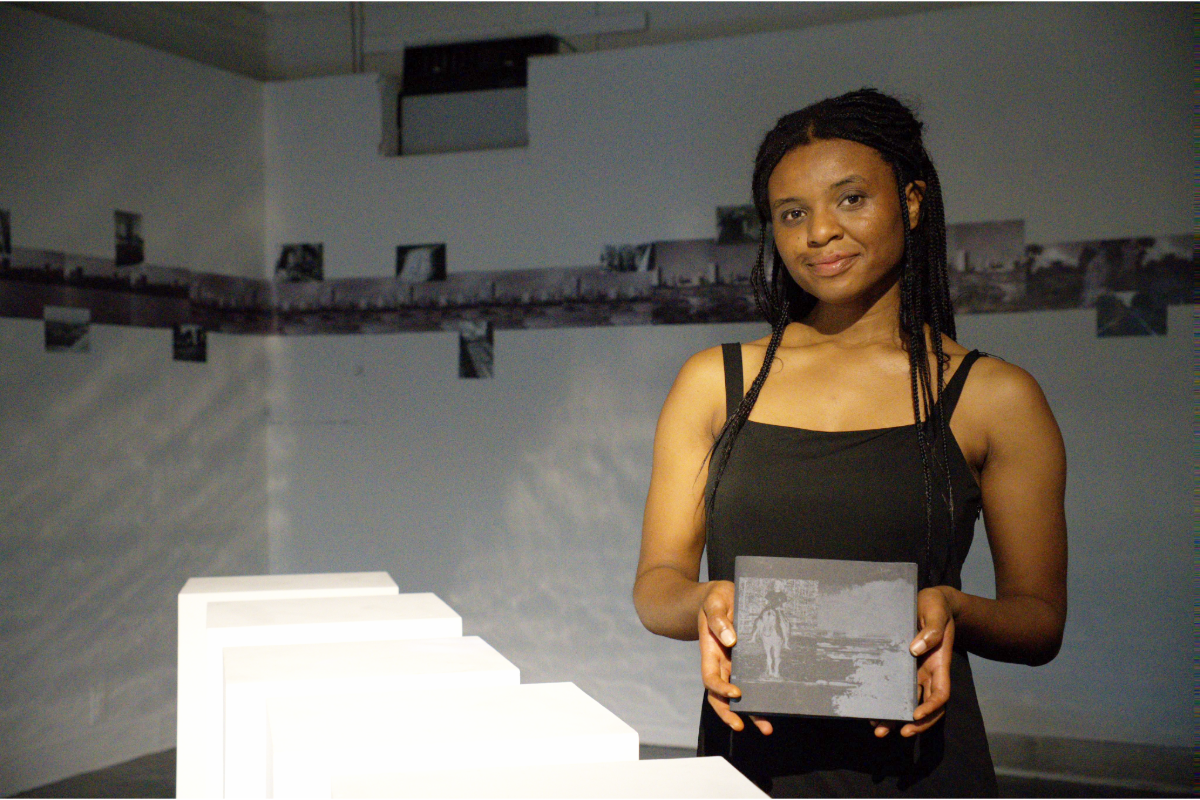
Nneoma Njoku, an MFA student in VCUarts’ graphic design program, was the 2025 Special Collections and Archives’ Artist-in-Residence. During her summer residency, she created an artist’s book inspired by the collections. Her practice took her between the streets of Richmond and the reading room at Cabell Library, blurring the lines between text and art, public and private.
River Monuments is on display at the Anderson Gallery through October 18. The exhibit draws on the library’s collections to portray the river, known originally as the Powhatan and now the James, flowing through the center of Richmond.
Njoku spoke on why the river is at the centerpiece of her work:
“The river outdates all human activity in the area. The people, buildings and culture have changed (violently and nonviolently), and the river has been here to witness it all. I am interested in showcasing the livelihoods and stories that have been lost and purposely removed from our conception of Richmond - the stories of non-sentient things, individual or communal micromoments, the quieter moments in a community's history, no matter how disparate and mundane, as connected and powerful forces in history-making and without which this city wouldn’t be what we know.”
“I am interested in translating and depicting a world where the river has engraved these lost or hidden moments into its memory. In a way, I see my work as a decolonial project, as I am committed to understanding a place in a way that makes room for nature, all groups of people, objects, and the ‘illogical’.”
Richmond’s natural scenery impacted Njoku. The artist moved to Richmond in August 2024, having previously lived in Philadelphia and Atlanta. While Richmond was a change of pace, its environment helped shape her own relationship to the city. “I spent a good chunk of my free time this summer going on long bike rides and documenting the unique things I saw, as well as people watching in parks and cafes. I viscerally felt the layers of Richmond’s history as I explored various neighborhoods and the river.”
“Of course I encountered the general history taught in school that’s reinforced with the numerous plaques and statues within the city, but as I saw the old homes, alleys, stone paths, and countless strangers, I thought about the lost and buried parts of Richmond’s story - the generations of people, seasons, and nature that are truly responsible for the city’s turning cycles. My goal was to translate this feeling into my book.”
As Njoku began her residency, she discovered the Special Collections’ archival documents of Richmond history. The RG-60 photograph collection proved instrumental. These largely unlabeled, undated photos showcased amateur photographs of the greater Richmond area in the 20th century.
Njoku remarks, “I was thinking of Richmond, which contains numerous monuments and plaques with questionable versions of history that contain gaps and omissions, and turning my imagination to what the river’s version of history would look like.”
“As I explored Richmond this summer, it seemed to me the real monuments are what some might call mundane and nonsensical - people sitting on porches, a girl skating, community members winning awards, abandoned buildings, quiet moments, nature, playful moments. I felt committed to tell a story of a place where these are the makers of history, deserving of recognition.”
As she parsed through Special Collections’ RG60 archives, many of the photos contained no information on the subject or the time period. She tried to find photos that replicated the moments similar to those she had seen in real time. The most important image is a young girl on a horse. The only information available about the photo is that it was taken during a Richmond YWCA summer camp in the 1970s. “I wondered who she grew up to be, the lives she touched, no matter how small, her children, her partner. She is a part of Richmond’s story. To me, this image served as a foil to the numerous Robert E. Lee statue images I saw while researching, and a microcosm/epitome of what I aimed to do with this book - making strangers the everyday monumental figures in Richmond’s story.”
River Monuments is not Njoku’s first experience with book arts. Creating fan zines on her own and playing with nonlinear book formats in the graphic design department led to curiosity around books as a form for creation. “I really enjoyed the process of collecting content and organizing it to create a meaning. I also fell in love with the artistic and intellectual freedom the book space provided, and was attracted to the idea that if you can fold, bind, and print, you can publish whatever you want.”
She considers this a branch of her work in graphic design. “All of my coursework placed emphasis on the importance of form and material in conveying meaning. It made me ask the question: How can you break from traditional forms of the book to knowledge-making in ways that circumvent Western modes of thinking and learning? What are other forms that the book can come in other than the codex and its predecessors?”
These questions influenced Njoku’s research as she delved into the connections between culture and the literature used to name and typify it. Her work joins a conversation around the structuring of racialized identity through codified “nonfiction” accounts, engaging with and reinventing the medium as a way to address its flaws.
“My book’s images are entirely sourced from archives, and this is a process I want to continue to use in my work, perhaps with a more surrealist tone. I love the idea of creating stories with the strangers I see in the archives…[it] has influenced my own imagination, where the river remembers what history did not.”
A physical exhibit of Njoku’s artist’s book River Monuments is on display at The Anderson until October 18. She will give an artist’s talk at the gallery on October 1 at noon.
Interview by VCU Libraries Communications Intern Basil Forrest.
< Previous Next >